A daily unit of progress
The commitment was to build each day. A day’s output could be a focused module within a larger tool.
Why it matters
Keeping the daily scope manageable let a larger prototype develop across several days.
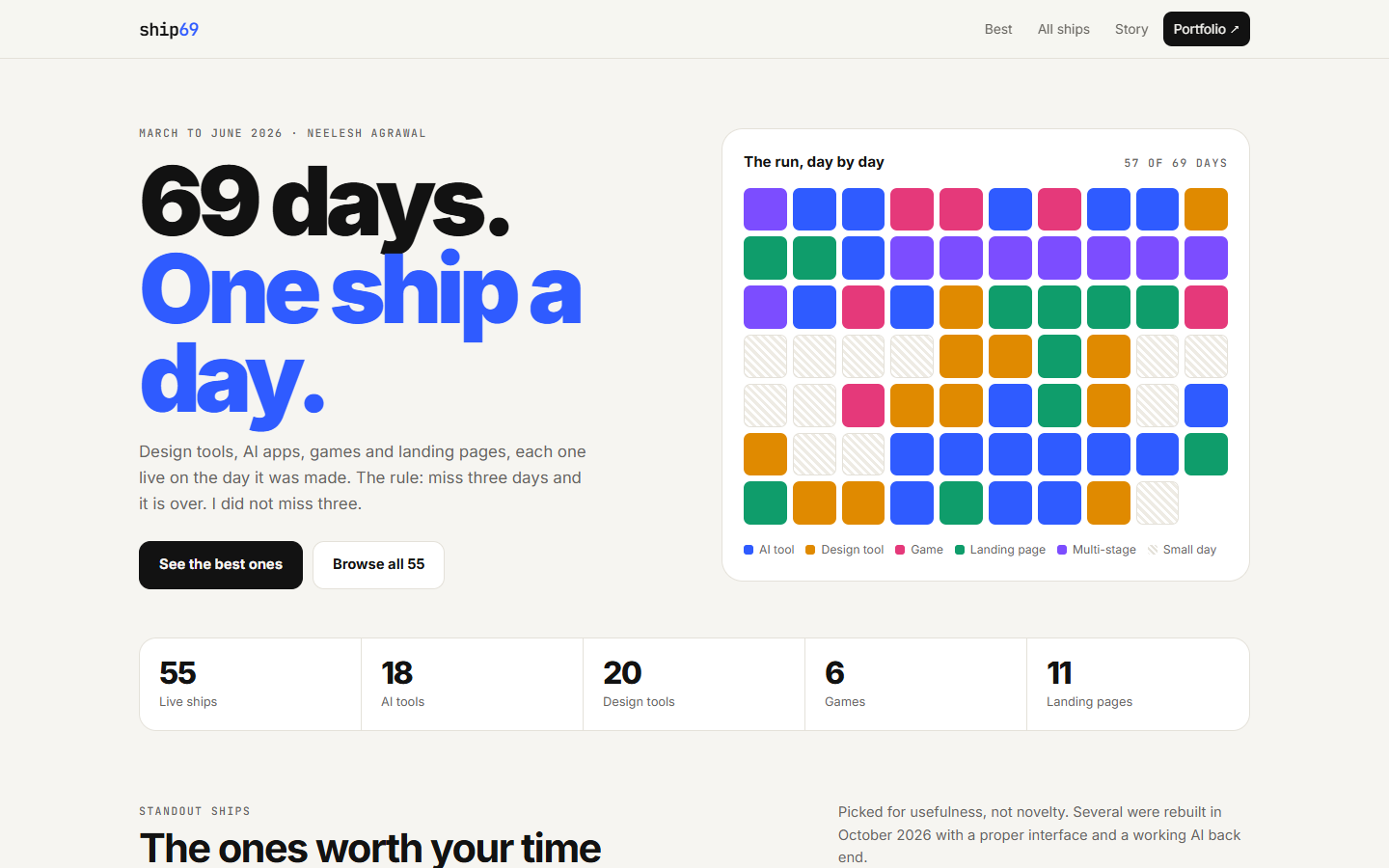
65+ projects and experiments across tools, websites, apps, and games.
I took on a 69-day challenge to build regularly with AI and code. Some days produced a complete prototype; larger tools took two or three days, with one module built each day.
I used Claude, Cursor, and AI-assisted development to build prototypes and record daily progress in the Ship69 archive.
A self-initiated challenge to practise across different products, with deliberately varied scope and polish.
I picked a prototype or module, built it with AI assistance, and documented the day’s work. When a tool needed more time, I continued with its next module on the following day.
Design decisions
The commitment was to build each day. A day’s output could be a focused module within a larger tool.
Keeping the daily scope manageable let a larger prototype develop across several days.
Some tools took two or three days. I built their modules one at a time and recorded that sequence in the archive.
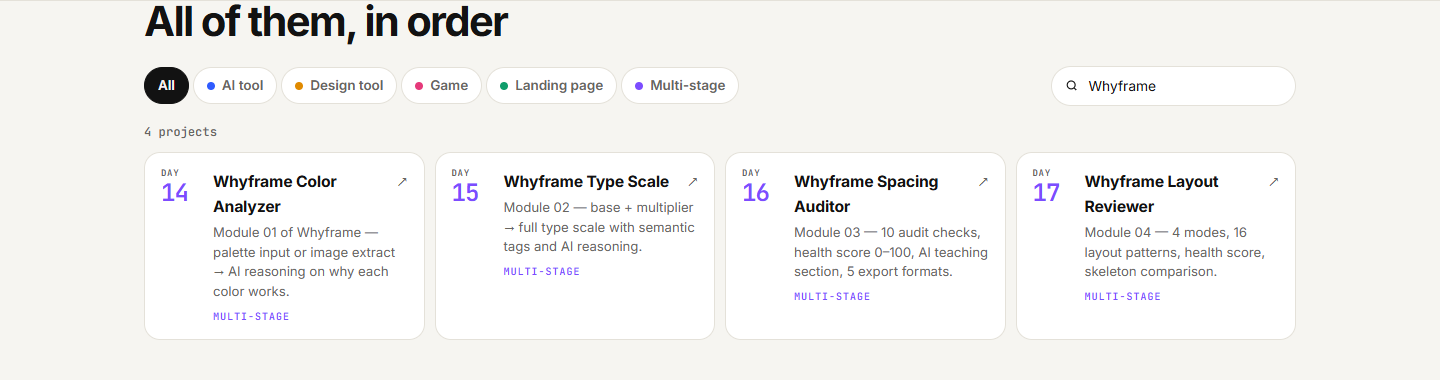
The daily record explains what was built without presenting each module as a separate finished product.
Where it landed
Built a collection of 65+ projects and experiments over the challenge. The archive records the work completed each day, including modules belonging to larger tools.
Explore live ↗Reflection
The challenge gave me repeated practice turning an idea into a working prototype with AI assistance. The archive is a record of that practice.
For larger projects, breaking the work into daily modules let me continue making progress without pretending the entire product was completed in a day.